Ever wondered about the best way to invest in our future? Nobel laureate Professor James J. Heckman offers a powerful answer through his groundbreaking work, often summarized as the "Heckman Equation."
Excerpted from Heckman Equation official website
At its core, the Heckman Equation isn't a complex mathematical formula you need to solve, but rather a compelling economic argument. It highlights that the highest rate of return in human capital development comes from investing in the earliest years of a child's life—from prenatal development through early childhood (around ages 0-5).
What Does This Mean for Parents and Society?
Professor Heckman's research, for which he won the Nobel Memorial Prize in Economic Sciences, demonstrates that high-quality early childhood education and nurturing environments provide far greater societal and economic benefits than interventions later in life, such as job training or even schooling at older ages.
Think of it like building a strong foundation for a house. The earlier and more robustly you build that foundation, the stronger and more successful the entire structure will be. Early investments in children's health, nutrition, and learning lead to:
[1] Better cognitive and non-cognitive skills (like curiosity, self-control, and social skills)
[2] Improved educational outcomes later in life
[3] Greater success in their careers
[4] Reduced social costs in areas like healthcare and crime
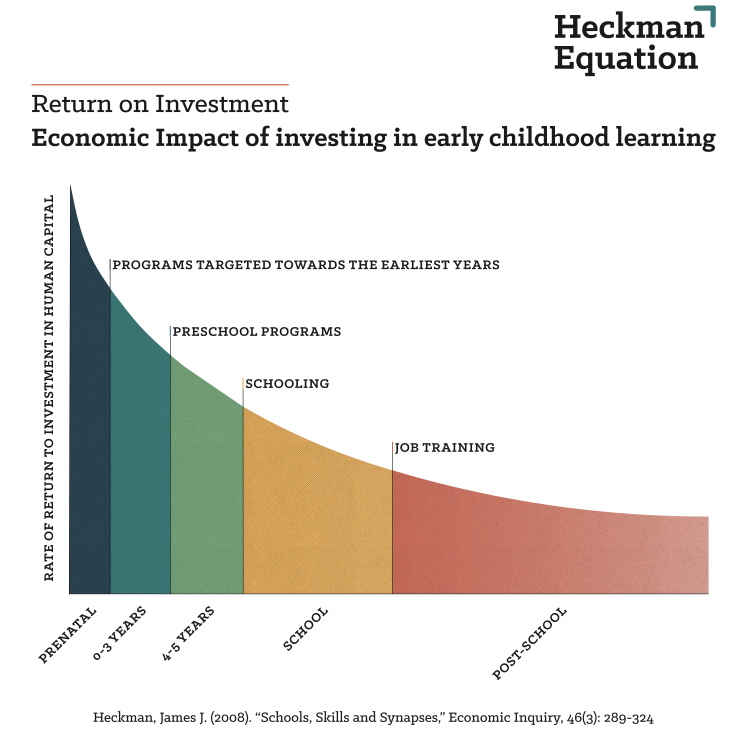
The graph often associated with the Heckman Equation visually depicts this: the return on investment is highest in the prenatal to 5-year age range and gradually decreases as individuals get older.
The Takeaway:
The Heckman Equation underscores a crucial message: investing in our youngest children, through programs like quality preschool, parental support, and early learning initiatives, isn't just a social good—it's a smart economic strategy that yields significant long-term dividends for individuals and society as a whole. It champions the idea that nurturing potential from the very beginning is key to unlocking a brighter future for everyone.
(Based on the work of James J. Heckman, including "Schools, Skills and Synapses," Economic Inquiry, 2008)