Circles, squares, triangles – oh my! Recognizing shapes is a fundamental early math and cognitive skill. It helps children understand and organize the visual information around them, forming a basis for geometry, reading, and even art. Learning shapes involves:
-
Visual Discrimination: Telling the difference between shapes.
-
Vocabulary: Learning the names of shapes.
-
Understanding Properties: Recognizing that a square has four equal sides, and a triangle has three.
-
Spatial Reasoning: Seeing how shapes fit into the world.
Sometimes, a new shape might seem confusing, or a child might mix them up. This is a wonderful time to apply a growth mindset. Instead of "I don't know that shape," we can encourage, "You're still learning about shapes, and that's okay! Our brains get smarter when we practice looking closely." This approach celebrates the learning process and trying new things.
Let's become shape detectives and explore circles, squares, and triangles!
Goal: Learn to Identify Shapes (Circle, Square, Triangle)
A visual TaskBoard can turn shape learning into an exciting game! Here’s how you can break down this "Study Support" goal into "bitesize" tasks:

1. All About Circles! (The Round Shape)
-
Task: Find Something Round (Circle Hunt!): "Let's look around the room. Can you find something that is round like a circle?" (e.g., a ball, a clock face, a plate).
-
Task: Trace a Circle: Use a stencil, the bottom of a cup, or draw a large dotted circle for them to trace. Talk about how it has no corners.
-
Task: Match Circle Shapes: Have cut-out circles of different sizes and colors. "Can you find all the circles?"
-
Task: Say "Circle" When You See One: Practice naming the shape.
2. Super Squares! (The Shape with Four Equal Sides)
-
Task: Find Something Square (Square Hunt!): "Now let's look for squares! Remember, a square has four sides that are all the same length, and four pointy corners." (e.g., a block, a tile, a window pane).
-
Task: Count the Sides of a Square: Use a toy square or a drawing. "Let's count: one, two, three, four sides!"
-
Task: Build a Square with Sticks: Use craft sticks or straws to form a square.
-
Task: Say "Square" When You See One.
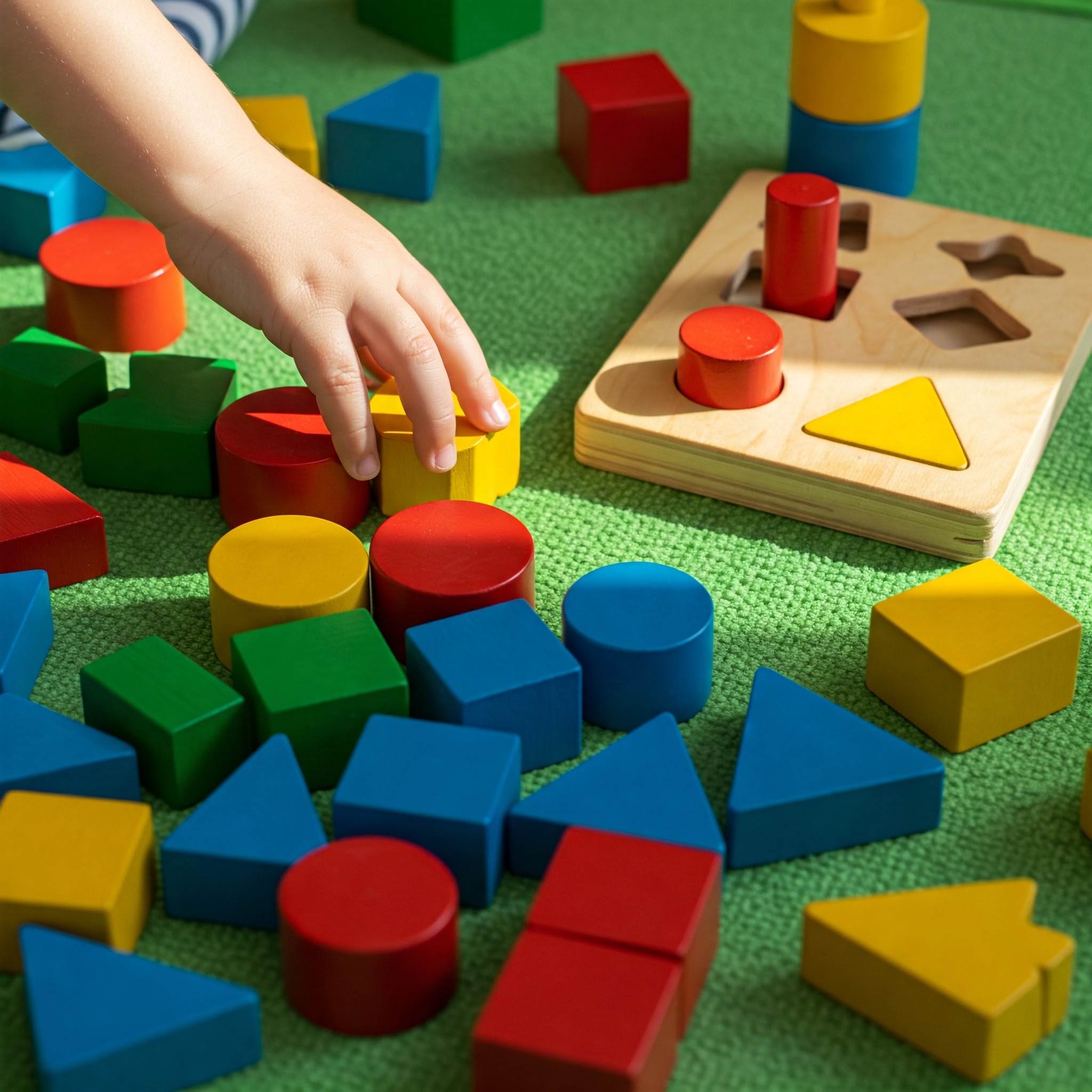
3. Terrific Triangles! (The Shape with Three Sides)
-
Task: Find Something with Three Sides (Triangle Hunt!): "Triangles have three straight sides and three pointy corners. Can we find any?" (e.g., a slice of pizza (roughly!), a yield sign, a roof shape in a drawing).
-
Task: Count the Sides of a Triangle: "One, two, three sides make a triangle!"
-
Task: Make a Triangle with Your Fingers: Show them how to make a triangle shape with their hands.
-
Task: Say "Triangle" When You See One.
4. Shape Sorting Fun!
-
Task: Sort a Mix of Shapes: Give them a collection of circle, square, and triangle cut-outs or blocks. "Can you put all the circles in this pile, all the squares here, and all the triangles there?"
-
Task: Name the Shape Game: Hold up a shape and ask, "What shape is this?"
Tips for Shape Sleuths:
-
Make it Real-World: Point out shapes everywhere – in food, toys, nature, books, and street signs. "Look, the wheel on the bus is a circle!"
-
Hands-On Activities: Use shape sorters, puzzles, playdough to make shapes, or draw shapes with chalk outside.
-
Sing Shape Songs: Many fun songs teach shape names and properties.
-
Keep it Playful: Learning should be fun! Turn it into a game rather than a drill.
-
Growth Mindset Encouragement: "I see you're looking really closely at the sides to figure out if it's a square! That's great detective work!" or "You didn't know that was a triangle yesterday, but you learned it today! Your brain is growing!"
-
TaskBoard Progress: Checking off each shape hunt or sorting activity on a TaskBoard gives children a visual sense of accomplishment and makes learning feel like a successful mission.
Learning to identify shapes is a key step in understanding the world. By making it an interactive and encouraging experience, you help your child build important cognitive skills and a confident, "I can learn this!" attitude. Happy shape hunting!